
In the heavy industrial sectors of Australia, ranging from oil and gas refineries and chemical processing plants to municipal water treatment facilities, industrial tanks are the silent workhorses of production. Day in and day out, these massive vessels hold thousands of litres of chemicals, wastewater, crude oil, or manufacturing byproducts. Over time, however, an inevitable problem develops: accumulation.
Sludge settles at the bottom, scale bakes onto the internal walls, and stubborn chemical residues harden into thick, unyielding crusts. Left unchecked, this buildup reduces tank capacity, chokes internal pipework, risks product contamination, and compromises structural integrity.
Yet, for facility managers, the prospect of tank maintenance often triggers an immediate headache. Traditional cleaning methods are notoriously slow, labour-intensive, and inherently hazardous. Every hour a tank is offline for cleaning represents a direct hit to the facility’s bottom line. In an era where operational efficiency dictates market competitiveness, taking a critical asset offline for weeks is no longer a viable option.
The solution driving a paradigm shift in industrial maintenance across the country is high-pressure water jetting, specifically when engineered as a high-flow system. At Silver Raven, we have pioneered the integration of high-flow, ultra-high-pressure technology to transform tank cleaning from a dreaded logistical bottleneck into a streamlined, high-speed operation.
The True Cost of Industrial Downtime
To understand the immense speed advantage of high-flow water technology, one must first quantify the true impact of asset downtime. In heavy industry, downtime isn’t merely the absence of production; it is a compounding operational expense.
When a storage or processing tank is decommissioned for maintenance, the entire production chain must adjust. Upstream processes may need to be throttled, downstream distribution can be delayed, and backup storage solutions must be rented or rerouted. Furthermore, the specialised labour required to oversee traditional manual cleaning methods, often involving confined space entry, adds substantial overhead.
The primary objective of any modern asset turnaround manager is to compress the maintenance window as tightly as possible. Every day, shift, or hour shaved off the cleaning schedule directly reclaims lost revenue and reduces the total risk profile of the project.
Traditional Tank Cleaning vs. High-Flow Water Jetting
Historically, cleaning an industrial tank was a brutal, mechanical affair. Teams of technicians equipped with scrapers, chemical solvents, and low-pressure hoses would enter the vessel. This approach suffered from several distinct drawbacks:
- Extreme Slowness: Chipping away at hardened chemical scale or shovelling out heavy crude sludge manually can take weeks of continuous shift work.
- Chemical Hazards: Relying on aggressive chemical washes introduces secondary waste streams that require costly treatment and disposal, alongside health risks for the crew.
- High Risk Profile: Maximising the hours personnel spend inside a confined space inherently increases the statistical risk of a workplace incident.
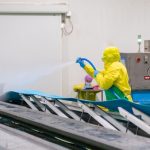
Modern high-pressure water jetting flips this equation entirely. By harnessing the raw physical force of water pressurised up to 40,000 PSI (and optimised with high flow rates), the process strips away contaminants mechanically, instantly, and without the need for abrasive chemicals.
When high pressure is paired with high flow (delivering a massive volume of water per minute), the system doesn’t just cut through scale; it rapidly flushes debris out of the tank, combining blasting and removal into a single continuous, high-speed motion.
The Mechanics of Speed: Why High-Flow Systems Blast Through Deadlines
The speed advantage of high-flow high pressure water jetting boils down to advanced fluid dynamics and specialized automation. It is a dual-force approach that addresses both the breakdown and evacuation of waste.
Macro-Fracturing of Hardened Scales
Ultra-high-pressure water acts like a precision kinetic knife. When directed at a hardened substance, such as cured polymers, bauxite buildup, or calcium scale, the water penetrates microscopic pores and fractures the material from the inside out. Instead of grinding the residue away grain by grain, high-flow jetting shears off massive chunks instantly.
Rapid Sludge Evacuation
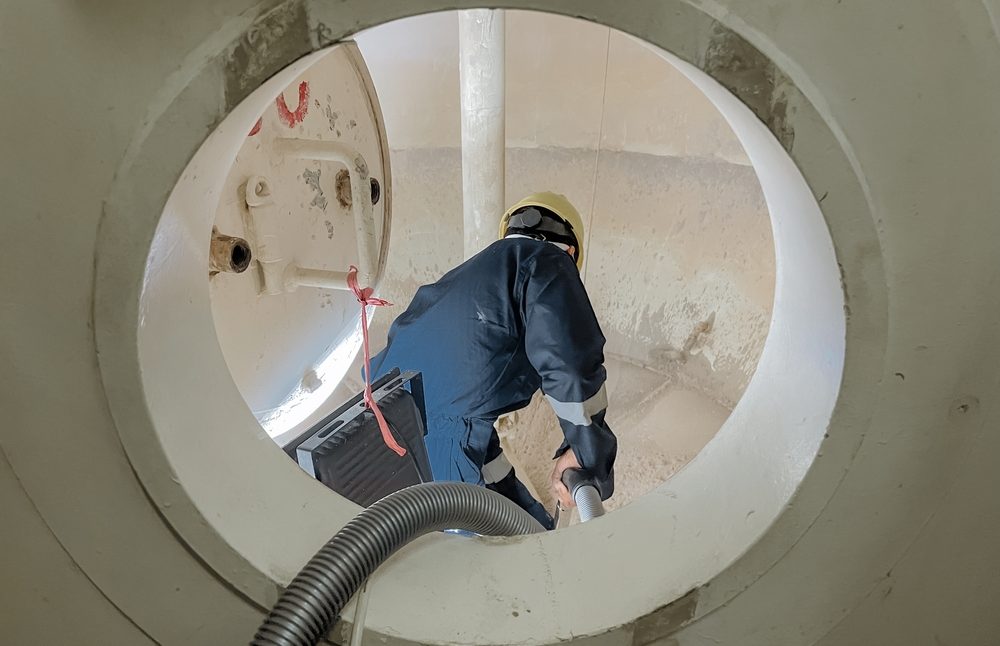
High pressure cuts the material, but high flow moves it. In large holding tanks containing thick, viscous sludge, low-flow systems simply create a hole in the mud without moving the bulk mass. High-flow systems unleash a torrent of water that liquefies heavy solids on contact, creating a pumpable slurry that can be simultaneously vacuumed out of the tank.
Automated 3D Tank Cleaning Heads
The pinnacle of speed is achieved by eliminating human limitations. Rather than having a technician hold a manual lance inside the tank, modern operations utilise automated, multi-axis 3D rotating jetting heads. These units are lowered into the tank through existing manways. Once activated, they rotate through a precise, pre-programmed three-dimensional pattern, striking every square centimetre of the tank interior with relentless force.
Safety: The Enabler of Efficiency
In the Australian industrial landscape, safety and speed are intrinsically linked. A fast process is useless if it is compromised by a safety incident that shuts down the entire worksite.
The greatest operational advantage of automated high-pressure water jetting is its ability to facilitate No-Entry Tank Cleaning.
By controlling the hydro-demolition and jetting equipment remotely from outside the vessel, facility managers can eliminate the need for routine confined space entry. This drastically reduces the time spent on complex safety permitting, breathing apparatus setups, standby rescue teams, and continuous gas monitoring. The crew can set up the equipment rapidly, initiate the automated blast cycle, and monitor the progress via specialised cameras, cutting down the project timeline significantly.
Environmental and Structural Integrity Wins
Beyond raw speed, high-velocity water technology offers unparalleled protection for the asset itself. Traditional mechanical scraping can gouge internal steel walls or damage sensitive protective linings, leading to premature structural failure or corrosion. Water jetting is entirely non-abrasive to parent metals; it selectively destroys the contaminant while leaving the underlying steel completely pristine.
Additionally, because the system relies solely on pressurised water, it eliminates the need for thousands of litres of chemical neutralisers. The resulting waste stream is clean, consisting only of the water used and the material removed, making waste management fast, transparent, and compliant with strict Australian environmental regulations.
The Silver Raven Standard in Industrial Services
Executing a high-flow, high-pressure clean safely and efficiently requires far more than just renting a pressure washer. It demands heavy engineering expertise, a state-of-the-art specialised fleet, and an ironclad commitment to operational precision.
At Silver Raven, we provide turnkey industrial solutions across Australia. Our custom-engineered jetting rigs are built to handle the harshest industrial environments, delivering optimal pressure-to-flow ratios tailored to the exact chemical composition of your tank’s buildup. Our teams design bespoke lift, placement, and automated blast plans for every project, ensuring that when we roll onto your site, we execute the turnaround with absolute speed and zero guesswork.